Friday, 22 October 2021

These are the Names

In the first weekday Mass that I celebrated, a chalice with hosts (a ciborium) stood on the altar. However, I had forgotten to place it on the small white linen cloth that is spread out halfway during the Mass (the corporal). I had also forgotten to remove the lid from the ciborium. As the time came to distribute Communion, I was suddenly faced with a major problem: could I distribute these hosts as the “Body of Christ”, because they had been on the altar? Or was it still only ordinary bread, because it had not been placed on the corporal, and would I commit idolatry by calling it the “Body of Christ”?

I have become rather a fan of the book These are the Names by Tommy Wieringa. It is more exciting than the story above, but to my mind, there is a connection. Spoilers alert!

These are the Names has two main storylines. The first one concerns a band of refugees in the former Soviet Union, no friends of each other but clinging together for a greater chance at survival, making their way across a barren wasteland, hoping to find a habitable place to live. They remember being in the back of a truck, and a moment of tense silence at a border crossing – which would presumably make them ‘illegal aliens’.
Because of the harsh conditions, some of them fall sick or die. But in the end, the remaining five struggle into the town of Mikhailopol.

The second storyline concerns the police chief of Mikhailopol, Pontus Beg. He is part of a corrupt system and has made his peace with the occasional indulgence of dishonesty or violence, though he is not a bad man in general. He has been in love once, a relationship that did not last a year, and since then has been relatively successful in ignoring his grief and settling into a convenient life. He has a sexual relationship with his cleaning lady, which could be considered an abuse of power and a boundary violation; but while she is dependent on him economically, she holds the power in the relationship, as she decides the time and frequency of their sexual encounters (only during infertile periods).

Near the beginning of the book, the Jewish rabbi of Mikhailopol dies, and there are no other Jews in town. The responsibility of organizing the funeral falls on Pontus, who finds himself confronting the puzzling question: how does one bury a Jew? At a loss, he visits the rabbi of a neighbouring town, Zalman Eder. As Pontus learns more about Judaism, he becomes intrigued by it, and eventually he finds out that his mother had a name of Jewish origin. Was she a Jew? And if so, has Pontus always been a Jew without realizing it? Is he accidentally within the boundaries of the community chosen by God?

The title of the book, These are the Names, corresponds to וְאֵלֶּה שְׁמוֺת, the opening words of the book of Exodus (of which the Hebrew name is Shemot, ‘Names’). Exodus is about a chosen community leaving behind their old life of enslavement, oppression and scarcity. Through the agency of Moses, they are liberated by God from the Egyptians while passing through the Red Sea. At Mount Sinai, God gives them directions about how to live, and promises that He will lead them to a good land. But while the book looks forward to the Promised Land, they never actually get there.
In fact, we learn from the other Books of Moses that most of the people who set out from Egypt die on the desert journey. Even Moses himself dies in the desert; he sees the Land but does not enter it. That is the task of his successor, Joshua / Yehoshua.
Christians believe that a certain Jew named Yeshua (a variant of Yehoshua) has crossed the boundary of the spiritual Promised Land and that everyone who believes in Him already lives there with Him. Jews are sceptical of this claim and argue that no such boundary has been crossed.

Some of the refugees are Christian, including a man from Ethiopia. He does not speak the others’ language, but he is seen kissing a cross. Another refugee from Ashgabat considers this insulting, because to him Black men are on the level of animals, and so they do not belong within the community that honors God.

Pontus is probably Christian in a vague cultural way. From the Jewish perspective, however, he is a goy. He learns that while it is possible for a goy to embrace the Jewish customs and to study the faith, he will always lack something. If he is not biologically related to the patriarchs, he will always lack something undefinable that is passed down in Jewish heredity. The rabbi tells him, ‘The goy can cross the bridge but never reach the other side.’
Pontus reads in an old Jewish book (all translations are mine):

The Jews are not bound to the Torah because God has created us, but the Torah was given to us because God brought us out of Egypt, because He has bound himself to us and because we have been chosen. If this were otherwise, Blacks and Whites would be equal as well, because God has created all people.

Of course, there is an indication that Pontus is possibly Jewish. In that case he would be able to live as a complete Jew. But perhaps he does not want to become a Jew. For one, his cleaning lady would not understand and probably disapprove of his being circumcised.
However, he is fascinated by the ritual bath of Judaism:

He was not sure if it was allowed, but sometimes he longed, even more than for the Eternal One, for submersion in the mikve, the stone niche deep in the earth, where the living water would cleanse his soul.

But Pontus will always be Pontus: a ‘bridge’ hovering over the water, connecting two shores. You start with the Baptist, you end up with a Pontifex – that is what history does.

The longing to start a new life is mirrored in a more fear-filled conversation with one of the refugees:
‘Where are you from? Is there someone we can inform that you are here? Wife, children, family? Someone will want to know where you are?’
‘No family.’
‘And where are you from?’
‘The hedge… The hedge of terrors.’
‘What is that?’
‘The poacher says…he says we should cross it, in order to be at home.’

Near the end of the book, we discover that the refugees have been deceived. The people who took their money to get them across the border did not want to run any risks. The border crossing that the refugees remember was artificial, fake: in reality, there was no border. They are in their own country after all, even if they cannot prove it. However, that does not matter – there are also Chinese immigrants, and as long as they are harmless, no one investigates too closely.

Likewise Pontus does not know which country is his home: the Promised Land, or the lands of the goyim. He is invited to cleanse himself in the mikve, but hesitates and refuses. He finds consolation in participating in Jewish rituals with the rabbi in the other town, without choosing on which side of the boundary he wants to live. The rabbi does not have that liberty: he is clearly a Jew living in a foreign land, but he is alone, old and tired, he does not have prayer services and does not observe all the commandments.

In the final chapter, Little Moses, Pontus takes a young boy, one of the refugees, to the border of his own country. The border is heavily guarded from the other side. The other side offers a better life, so obviously the government there has an interest in limiting the influx of migrants. It would be very unlikely that the boy could cross that border, given the technology they have to hunt down trespassers.
Pontus offers the boy to become his adoptive father, to give him a chance of acquiring an Israeli passport, permission to enter the Promised Land.
Pontus, who is perhaps a Jew, will perhaps become the legal father of someone who will perhaps have better opportunities after crossing the borders of the Promised Land. Within those boundaries is life, outside of the boundaries is struggle.
The boy gazes into the distance. What he thinks or what he chooses, we do not know.

In my first weekday Mass, rather than repeating the long Eucharistic Prayer and upsetting the congregation, I distributed the hosts from the ciborium that had escaped my attention, and proclaimed them to be the “Body of Christ”. After Mass, I went to the tabernacle as secretly as possible and whispered the words of the consecration of the bread once again, under my breath. Consecrated hosts and unconsecrated hosts should always be kept clearly apart.
Sometime after that experience, I talked to a young colleague who asked with some surprise, ‘Did you not form an intention before your ordination either to consecrate only the bread and wine on the corporal, or all the bread and wine on the altar?’
I never did.

Wednesday, 14 July 2021

Space for the Imperfect

I do not read Italian easily. When I read Fratelli tutti, I read it in English. Some time afterwards, I was invited to give a talk about it for a Dutch group. To my surprise, in almost every memorable phrase I wanted to quote, I found the Dutch translation lacking. This surprised me, as it had been produced by the Flemish, who tend to combine accuracy with readability.

(For some reason, the Netherlands insist on producing their own Dutch translations in addition to the Flemish ones; these are usually well-intentioned but overly literal and rather clunky as a result.)

Some examples of nuances that got lost in the Flemish translation:

Sapore

(1) il gusto e il sapore della realtà (FT 33) has been translated as de smaak en geur van de realiteit (the taste and smell of reality). English: “the taste and flavour of the truly real”. Flavour is more than smell. As far as I know, gusto and sapore both mean “taste”, but gusto is the taste you have for something (appetite), whereas sapore is the taste something has of itself.

In the first paragraph Pope Francis refers to il sapore del Vangelo “the flavour of the Gospel”. His choice of words connects the Gospel and reality, in the sense that both have a “taste” that can be appreciated. This fits squarely into the Ignatian spiritual tradition.

Also, the use of sapore makes it possible to point out that sapiens, the Latin word for “wise”, literally means “tasting”. Wise discernment, then, is only possible when one knows the flavour of the Gospel and of reality. And flavour is more than smell, because it is connected to nourishment, to that which feeds us, becomes part of us and gives us life.

(The Kantian adage Sapere aude! “Dare to know!” could also be translated as “Dare to taste!” Although this maxim might not be universally approved of, certainly not by Kant.)

Per questo

(2) About the Samaritan in the parable, Pope Francis writes: La dedizione al servizio era la grande soddisfazione davanti al suo Dio e alla sua vita, e per questo un dovere. (FT 79)

This has been translated: Zijn poging om iemand anders te helpen, gaf hem grote voldoening in het leven en tegenover zijn God, en betekende voor hem gewoon zijn plicht doen. (His attempt to help someone else gave him great satisfaction in life and before his God, and meant for him simply doing his duty.)

English: “His effort to assist another person gave him great satisfaction in life and before his God, and thus became a duty.”

In this case, I think both translations fall short. They refer to an isolated incident, an “attempt” or “effort”, whereas the original speaks of dedizione al servizio (dedication to service) as a character trait. But later in the sentence, the English gets something right which the Dutch doesn’t, because the Dutch simply juxtaposes “satisfaction” and “duty”. In both the Italian and the English, it is quite clear that duty is causally subordinate to satisfaction: service gave the Samaritan great satisfaction, and per questo “thus” it was a duty.

This, too, is part of Ignatian spirituality: your heart’s joy indicates your appointed path.

Nessuno si salva

(3) Repetition is a form of emphasis. There is a phrase that occurs three times: nessuno si salva “no one is saved”. Obviously this verb, while it could refer to any threat, has a strong theological connotation: being saved from sin to live in nearness to God.

These are the three times it is used in Fratelli tutti:

- ci siamo ricordati che nessuno si salva da solo, che ci si può salvare unicamente insieme (FT 32). English: “Once more we realized that no one is saved alone; we can only be saved together.”

- hanno capito che nessuno si salva da solo (FT 54). English: “They [viz. the people who provided essential services during the pandemic] understood that no one is saved alone.”

And then the clincher:

- Abbiamo bisogno di far crescere la consapevolezza che oggi o ci salviamo tutti o nessuno si salva (FT 137). English: “We need to develop the awareness that nowadays we are either all saved together or no one is saved.”

A bold statement that could give any traditional systematic theologian an outbreak of rashes. I don’t know if they were on the Flemish translation committee, but this translation certainly neutralizes the impact:

We moeten het bewustzijn ontwikkelen dat we de problemen van onze tijd alleen samen of helemaal niet zullen oplossen (We need to develop the awareness that we will solve the problems of our time either together or not at all).

Come on – “solving” is not “saving”, let alone “being saved”! I suppose the Flemish decided on a more optimistic translation of ci salviamo, “we are saved” which can also be translated “we save ourselves”. But still!

(Side note: it is interesting that the statement “no one is saved alone” is always prefaced by a verb of mental activity: ci siamo ricordati “we remembered”, hanno capito “they understood”, far crescere la consapevolezza “make the awareness grow”.)

Focolare

(4) When discussing the importance of the State as a safeguard of tranquil family life, un caldo focolare domestico (“a warm domestic hearth”, FT 164) has been translated: een huis (a house). No comment.

A tense situation

These were sentences I wanted to quote to my Dutch audience, and at every turn I had to correct the translation. I knew something was off because I remembered it was different in the English translation. But while I was referring back to the Italian original, I noticed something else, a revolutionary point that has been erased in both the English and the Dutch translations.

You see, Pope Francis makes an unprecedented move in the last chapter on interreligious dialogue. He omits any reference to the Christian religion as the ultimate revelation which everyone is called to adhere to. But he does not minimize his own commitment to faith in Jesus Christ. In fact he says – and here I will quote the official English translation first:

“We Christians are very much aware that “if the music of the Gospel ceases to resonate in our very being, we will lose the joy born of compassion, the tender love born of trust, the capacity for reconciliation that has its source in our knowledge that we have been forgiven and sent forth. If the music of the Gospel ceases to sound in our homes, our public squares, our workplaces, our political and financial life, then we will no longer hear the strains that challenge us to defend the dignity of every man and woman”. Others drink from other sources.”

When I first read it, I thought the Pope went pretty far already with the concluding sentence, dropping this fact of life on his readers so casually and without any hint of regret or concern. Then I read the preceding quote in Italian, and my appreciation deepened.

Se la musica del Vangelo smette di suonare nelle nostre case, nelle nostre piazze, nei luoghi di lavoro, nella politica e nell’economia, avremo spento la melodia che ci provocava a lottare per la dignità di ogni uomo e donna.

Two letters made all the difference.

The English translation speaks of “the strains that challenge us”. This is the present tense, which may be used to indicate a general and abstract truth. Beavers build dams. Lampposts increase visibility and safety. The Gospel challenges us to fight for dignity. The present tense gently encourages us to include generally everyone in ‘us’, just as Red Bull’s slogan “It gives you wings” is not aimed at a specific ‘you’. And so, “The Gospel challenges us” becomes a statement about the Gospel, not about us.

(The Dutch translation suffers from the same problem: de melodie die ons oproept te vechten “the melody that summons us to fight” – also present tense.)

But this is different in the Italian. The tense is imperfect: not provoca, but provocava. The imperfect tense describes things that went on for a while, or habitually. The melody of the Gospel provoked us, or rather kept on provoking us to fight for dignity.

The imperfect tense gives the reader space to compare his own experience with the experience described. Perhaps he feels an allegiance to the Gospel, but does not remember it challenging him to fight for someone else’s dignity; in that case, perhaps it is not too late to make the experience his own. Perhaps the Gospel does not form part of his life story; in that case, he will have heard not a religious advertisement, but the sediment of an old man’s personal experiences and encounters. Which does not call for affirmation or rejection, but only asks to be taken seriously.

So much is lost when we do not give space to the imperfect.


(As I write this, I notice another discrepancy. If the music of the Gospel ceases to sound, then what? According to the English translation, we will no longer hear the strains that challenge us. This is a simple future tense: we will (not) hear. But the Italian uses a more complex tense, the futuro anteriore, a tense that takes a future vantage point in order to look back: avremo spento, “we will have turned off”.

If the melody of the Gospel ceases to sound, we will have turned it off.)

Friday, 28 September 2018

Baal ha-Khalomot

Disclaimer: moving around in Hebrew texts, I am like a half-blind man walking on crutches. It would be ironic if a text which revolves around the verb ‘interpret’ should receive a blatant misinterpretation from me, but the ironic and the actual have significant overlap, actually.

When the unsuspecting, though rather gossipy Joseph ben Jacob wanders into Dothan, looking for his brothers, they see him coming from afar and call him ba‘al ha-khalomōt, ‘master of dreams’. In their hatred, they throw him into a pit, and through an unfortunate series of events Joseph ends up in Egypt. There he rises in the ranks to become steward of Potiphar’s house, but through an incident with Potiphar’s wife, Joseph ends up imprisoned again. (The precise nature of the incident might be more dubious than it appears at first sight!)

In the dungeon he meets two officials of the King of Egypt: a cupbearer and a baker. One night they have a dream. For my studies, I was analyzing the chapter about these dreams (Genesis 40) and discovered some interesting details.

For starters, it is a bit ambiguous whether the cupbearer and the baker have different dreams at all. A hint is given that the dream has a different interpretation for each of them, but when the baker suddenly appears to have had a completely different dream, it is a bit surprising.

Prodded by Joseph, who asks them why they look so sad and then invites them to tell their dream because interpretations belong to God (the logic of this is somewhat elusive), the cupbearer begins elegantly, ‘In my dream ! a vine was before me, and in the vine were three branches…’

The dream branches out until it shifts to the cupbearer himself: ‘And the cup of Pharaoh was in my hand, and I took the grapes, and I pressed them into the cup of Pharaoh, and placed the cup in the hand of Pharaoh.’

Joseph has an extensive response. The first half is the interpretation of the dream itself; the second half is a request and a declaration of innocence. In the request, one action is emphasized: zākhar ‘remember’. Unfortunately, this gets lost in most translations.
The ESV has ‘Only remember me, when it is well with you, and please do me the kindness to mention me to Pharaoh, and so get me out of this house.’
More literally: ‘Only remember me close to you, when it is well with you, and do grant kindness to me, and remember me to Pharaoh, and get me out of this house.’
It is basically one job: ‘remember me close to you … remember me to Pharaoh.’

And then Joseph tells them that he was stolen away from the land of the Hebrews and that he has done nothing to deserve being kept ‘in the pit’, as he calls it – an old wound opens again.

Abruptly the story continues, ‘When the chief baker saw that the interpretation was favorable…’ (ESV)
The entire second half of Joseph’s speech is ignored. The baker does not even ‘see’ it, let alone remember it.
In this translation, another thing is not visible. Something even more fundamental than old wounds is echoed here: ‘And the chief baker saw that it was good.’ God’s praise of his creation is repeated. But it is out of place, because things are out of place: the light has been separated from the dark and somehow Joseph has ended up on the wrong side of the divide.

Incidentally, ‘interpret’ is a verb here. I would guess that the sentence could be translated ‘When the chief baker saw that he interpreted well’…

Then it is the baker’s turn to speak. His introduction is similar to the cupbearer’s, but it has none of the elegance. He declares, not ‘I also had a dream’ (ESV), but ‘Also I was in my dream.’ The baker starts with himself and reconstructs his dream upward from there: three baskets, food in the supreme basket (‘supreme’ because ‘elyōn is also a common title for God), and the birds above it who eat the food.
What is in the basket, precisely? According to the ESV, ‘all sorts of baked food for Pharaoh’. And even the interlinear translation does this. But if I’m not mistaken, the word ‘baked’ does not occur in the sentence: ’ofeh is the active participle of ‘bake’. What the baker carries around in his supreme basket is ‘all sorts of food for Pharaoh, works of the baker!’
You gotta advertise!

So we can sympathise, perhaps, when the cupbearer is restored and the baker is hanged. The story ends: ‘And the chief cupbearer did not remember Joseph, but forgot him.’

This is why I love the Old Testament: it always ends badly.

Remember.

Tuesday, 28 November 2017

Nel Mezzo del Cammin

This Sunday we celebrated the Feast of Christ the King. It was on this feast day that I first went to Mass, ten years ago now. I remember it, partly because I wrote about it. When Fr. Paul de Maat in Middelburg raised the chalice, I was ‘profoundly awed’, and could only think in brief lines from The Anathémata and traditional prayers.

Ten years later, I myself was raising the chalice – the first time in this church that this chalice was used, a chalice that I inherited from a predecessor in faith and in priestly ministry.

More precariously than he knows he guards the signa

Some fragments from the current time:

Yesterday was the first meeting of a group intended for thirty- and forty-somethings. It would not have started without an Italian couple, who have kindly, but regularly and persistently reminded me that such a group was lacking in our community. Through an accident of circumstance, it is now called the Panettone group. Mention was made of an Italian celebrity who could recite passages from the Divina Commedia for hours on end (without repeating himself, obviously). Hence the title.

For a reading group that meets this Thursday, I have started reading a modern book for young adults, inspired by Dante: Bianca come il latte, rosso come il sangue (White as milk, red as blood). It is about a normal 16-year-old boy, called Leo (I didn’t make this up), who likes to play football, grows nervous in silence, and who is deeply in love with someone called Beatrice.

The teachers have nicknames. The religious education teacher is a celestial priest who is well-versed in the Bible and whom Leo calls Gandalf. When a girl in class who is somewhat of a teacher’s pet makes a reference to Gollum, ‘Gandalf’ says, ‘I don’t know who this Gollum is, but if you say so, I believe it.’ And Leo reflects inwardly, ‘Gandalf doesn’t know Gollum, it seems absurd, but that’s how it is.’
This is too subtle to be merely a joke or an absurdity.

But there are many subtleties in the book. Leo attends a school named after a character from Mickey Mouse. In English known as Horace, the Italian name is of course Orazio (‘There are more things between heaven and earth, Horatio…’)
The new, young, and enthusiastic philosophy teacher is inspired by a movie called in Italian L’attimo fuggente (The Fleeting Moment) but known in English as Dead Poets Society (wink, wink).
And in the same (short) chapter, there is another ‘wink’ moment that even rhymes with this one:

Leo in latino significa “leone”. Leo rugiens: “leone ruggente”.
(Leo in Latin means ‘lion’. Leo rugiens: ‘roaring lion’.)

This time the author basically spells it out. Leo rugiens is a phrase from 1 Peter 5, which returns in the prayer of the Church every Tuesday night at Compline: ‘Be sober-minded; be watchful. Your adversary the devil prowls around like a roaring lion, seeking someone to devour. Resist him, firm in your faith.’
Leo does not seem particularly active in the resistance, but he is not spectacularly failing either.

As the title makes clear, colours are very important in the book. Red and white run through it as recurring themes. White is associated with silence, emptiness, infinity. Red is associated with overwhelming impressions, passion, love. ‘Beatrice is red,’ Leo grandly proclaims. But what he does not know (and what, so far, I have only gleaned from the summary) is that Beatrice suffers from leukemia: a Greek word (leukon haima) that means ‘white blood’.
It’s so good to read truly intelligent young adult novels.
(Leo also says: ‘Silvia is blue, like all true friends.’ The city of Delft has a big blue heart in the city centre. I feel quite at home here.)

Well, that’s enough about the book. Today I talked to someone who watched at a deathbed last week. And now my eye has fallen on the obituaries in the newspaper. I don’t usually read the paper, but scanning through it, I noticed a couple of things.
Firstly, there are many completely unfamiliar names among the youngest generation. Kayleigh and Kenza, Vaan and Keet, Vayènn and Lovis – next to the more reassuring Sven and Rik, Maarten and Tessa, Guus and Dirk.
Secondly, it is a common occurrence for deceased family members to be included in the obituary. But this is indicated in different ways; I see four in one newspaper. The traditional cross symbol is one. But another (a child) has a star. One obituary contains two different ways: a 96-year-old woman has a son with the words ‘(in loving memory)’ affixed to his name, but her great-grandson has a butterfly symbol in the same place.
Thirdly, there is another strange symbol that occurs in two different obituaries. Kira, Tessa, Britt, and Foxy have a dog’s paw after their name. Apparently the pets are so much part of the family that they are included, mostly in the absence of other children.

Dear future nephews and nieces, I admire how much you care for your pets – but if you will not keep their dirty paws from defacing my death notice, I am coming back to haunt you.

Sunday, 26 November 2017

Lost in Translations

For preparing my homilies, I tend to use the USCCB website. It has a nice little calendar that enables you to pick a date and get the Scripture readings for it – a feature no Dutch website has. But if you rely on it too much, you are in for some surprises.

The first surprise was months ago, on a regular weekday Mass at seminary, the memorial of Sts. Cyril and Methodius. I had been asked to provide the homily and had duly read the texts. When I arrived in the chapel, however, I discovered that Cyril and Methodius had been named co-patrons of Europe and were therefore celebrated with greater attention on this side of the ocean. That included special Scripture readings that reflected the missionary lifestyle of these saints.
So when one of the students started on the first reading, I had no idea what precisely it was going to be.
Fellow students told me later that my homily had been bolder and more passionate than usual.

The second surprise was later, on a Sunday in the parish, when the parable of the two sons was read. A father asks his two sons to work in his vineyard. The first one says no, but changes his mind. The second one says yes, but does not carry out the work.
It is interesting to reflect on the reasons why the second son says yes. Is it perhaps because he has heard his brother’s reply and wants to be better? Does he think: I’m the only one left, and if I don’t say yes, no one will?
These are attempts to add some dynamics to the story. But it requires some improvising and back-pedalling when, on reading the Gospel in church, you find out that the Dutch translation has the first son saying yes and the second saying no.

The third surprise came today, on the feast of Christ the King. The first reading from Ezekiel includes the following words (God in the figure of a shepherd speaking to His flock):
The lost I will seek out,
the strayed I will bring back,
the injured I will bind up,
the sick I will heal,
but the sleek and the strong I will destroy,
shepherding them rightly.
The theme of this passage fits well with the theme in the Gospel of Luke that God will have mercy on the lowly and punish the uncaring rich. There is an idea of separation (of the good and the bad) that is also expressed in the Gospel reading of the day, about the sheep and the goats. The ‘right shepherding’ is precisely this, that the weak are strengthened and the egoists are taken down a notch. And besides, even in regular shepherding practice, aren’t the healthy and fat animals chosen for slaughter?
It is unsurprising that the passage in Ezekiel continues:
As for you, my sheep, says the Lord GOD,
I will judge between one sheep and another,
between rams and goats.
Well, isn’t that a perfect parallel with the image of the Last Judgment in the Gospel?
It is, until you get to the Dutch translation, which goes something like this:
The lost sheep I will seek out,
the strayed I will bring back,
the injured I will bind up,
the sick I will strengthen,
and the healthy and strong I will continue to care for.
I will pasture them as it ought to be.
And you, my sheep – says the Lord God –
I will do justice to the one animal opposite the other,
opposite ram and goat.
This time, having grown hoar with age and wary with experience, I discovered the divergence before it was too late. I understand the connection between ‘judge’ and ‘do justice’. The link between ‘destroy’ and ‘care for’ remains a mystery. I thought it might be shrouded in Hebrew depths, but according to Strong’s dictionary, the verb שמד has the following meaning:
to desolate: – destroy, bring to nought, overthrow, perish, pluck down, X utterly.
So I just don’t know. In any case, this is why I still use the USCCB website, but always double-check.

Monday, 30 October 2017

Historian's Irony

Cardinal Newman said, ‘To be deep in history is to cease to be Protestant.’ That might be the case for systematic Protestantism along the lines of the Reformation, with a strict observance of the solas. It applies less obviously to a Protestantism that understands itself as a form of developing Christian faith that happens not to include a strong allegiance to the bishop of Rome.

Diarmaid MacCulloch is deep in history, and he has ceased to be anything in particular. Nonetheless he looks with understanding and sympathy on the spiritual and religious quests that have occurred in history and will no doubt continue to occur.

I am rereading MacCulloch’s book Reformation: Europe’s House Divided (1490-1700), which I first read 10 years ago while I was in the process of becoming Catholic, and which I am now reading in preparation for a historical trip to Germany in the footsteps of Martin Luther.

It is striking how religion and politics interplay, how allegiances and rivalries help to build consensus, and how people navigate a world with the consciousness of a last judgment, with a network of relations that has shifting perspectives on the wheat and the tares, and with the human needs that are basic to us all.

When King Henri IV of France (formerly King of Navarre) ultimately decided to convert to the Catholic Church, allegedly on the grounds that ‘Paris was worth a Mass’, this was the reaction of a prominent Reformer:

Theodore Beza, who all through his long years in Geneva had corresponded with Navarre, regularly received cash from him and was devoted to him as a new King David in Israel, was devastated at Henri’s betrayal of the godly cause. Beza nevertheless remained loyal, and sadly consoled himself with a different Old Testament image: God’s champion in Israel, Samson, sacrificed his life to slay his enemies, and now perhaps King Henri was making an even greater sacrifice of his soul in God’s cause. He also continued to regard himself as on King Henri’s payroll.

Monday, 9 October 2017

The Vineyard Song Remastered

Sometimes writing a homily is difficult. But at rare moments, hints are thrown at you from all sorts of different places and the homily basically writes itself.

This time it was the song of the vineyard in Isaiah 5, and the Gospel passage associated with it, of the wicked tenants who kill the vineyard owner’s son (Matthew 21). I thought to myself, didn’t Pope Benedict write something about this? He’s usually pretty good at contextualizing the parables and explaining how Jesus is inviting the Pharisees to let down their guard and join Him in his new creation.

Indeed the Pope wrote about this Gospel, and the Isaiah passage and even Psalm 80 in connection with it. Surprisingly, it can be found in the chapter on the principal images of the Gospel of John (Jesus of Nazareth I, ch. 8), under the heading ‘Vine and Wine’. Pope Benedict considers the Isaiah passage foundational for the vine motif, and writes:

The Prophet probably sang it in the context of the Feast of Tabernacles, in the context of the cheerful atmosphere characteristic of this eight-day feast (cf. Deut 16:14). […]
Everyone knew that “vineyard” was an image for a bride (cf. Song 2:15, 7:12f.), so they were expecting some entertainment suited to the festive atmosphere.

Many more interesting and edifying things were said about the passage, but this information made me see the whole passage in a different light. So I decided to take out a Hebrew-English Old Testament and see if I could make some sense of it, despite the fact that my Hebrew knowledge is sorely limited.

The first thing that stood out was that the song starts out very sing-song-y, which is recognizable as soon as you can read the Hebrew alphabet:
’āshīrāh nā līdīdī
shīrat dōdī l’kharmō

Li-di-di, it is as airy and light-hearted as fa-la-la. It means ‘for my beloved / friend’ and is related to dōdī (‘of my friend’).

The word is used twice, for the text continues:
kerem hāyāh līdīdī
b’qeren ben-shāmen
(‘My beloved / friend had a vineyard’, or more literally ‘A vineyard was there for my friend’: a possessive dative. And then, ‘On a very fertile hill’. ‘Vineyard’ and ‘hill’ are very similar words: kerem and qeren.)

Next I wanted to know if there was a similar play in the lines ‘He hoped it would yield grapes. Instead, it yielded wild grapes.’ In this I was disappointed:
wayqaw la‘asōt ‘anāvīm
wayya‘as b’ushīm
Yes, it rhymes, but that is only because -īm is the regular masculine plural ending. Nothing surprising there.
But wait…what was it that the man of the winepress was looking for? Grapes? Then why did it sound like something else? The word ‘anāvīm looked strangely familiar, and would look familiar to any amateur theologian worth three miserable grains of salt. There are some words that are known even to your average American Catholic blogger (no offense), and one of them is anawim, the ‘poor’ for whom poverty is a spiritual attitude. ‘Blessed are the poor in spirit’, the anawim. And indeed the word is almost identical in spelling to ‘anāvīm: ענבים and ענוים.
The almost-double meaning of ‘grapes’ is the first hint of the revelation in verse 7: ‘The vineyard of the LORD of Hosts is the House of Israel’.

Now I wanted to know if something similar applied to b’ushīm, the ‘wild grapes’. And while I could not find a similar word, I chanced upon the commentary in E.W. Bullinger’s Companion Bible, which told me two things:
(1) The word b’ushīm was derived from bashash [Strong suggests it’s actually ba’ash], meaning ‘to stink’ – which can easily shade into an aesthetic, ritual, or ethical judgment (in any language).
(2) Isaiah 5 is the only place in the Old Testament where qeren is translated ‘hillside’; all the other seventy-five times it means ‘horn’.

Wait, what? What did the text say again?

kerem hāyāh līdīdī
b’qeren ben-shāmen
‘My best friend had a “vineyard”
On a really fertile “horn” ’

They were expecting some entertainment suited to the festive atmosphere.

For more random wordplay, go and watch this clip.

Tuesday, 12 September 2017

Gas Stations

Since purchasing a car some three years ago, my life has been characterized by increasing mobility. My being on the road has led to a deeper appreciation of an ubiquitous feature of roads: gas stations.

They are much more than places to refuel your car. They are small dots on the map of hospitality and friendly interaction with passing strangers – who for a change do not pass at 100 or 130 km/h. They are cafés where you can get coffee and restaurants where you can purchase lunch, cold or hot. They are places of sanitary relief, of fresh air and stretched legs.

You can count on them being there, and on them being there for you even if you have never visited them before.

Even the layout has a comfortable familiarity everywhere. There is a place where you can get fuel, with lots of space around it to park your car for quick purchases. And there is also a parking space that can be used for a real driving break.

They can even function as inns, these gas stations. Last night before 11pm, when driving from Roelofarendsveen to Ridderkerk, I felt myself getting tired and stopped at a gas station between Delft and Rotterdam for a ten-minute nap. But when I opened my eyes again, it was after 1am.

Although I am very happy with my new home, now almost finished, I think I could get used to living in my car, as long as there would be gas stations along the road.

Saturday, 29 July 2017

Schroom

It’s been a while, I know. Lent, Easter, and the Ordination all conspired to keep me from posting; or perhaps it is my fault. In any case I was very glad to see how many people sacrificed time to come to the Ordination. I was particularly touched by the presence of some American friends; Youth Choir Faith, which sang a few hymns at the Mass; and one or two special friends.

Since then I have been on holiday, another mountain-hiking holiday in Austria. We stayed for two nights at a convent of the Canons Regular of the Holy Cross (O.R.C.) and then continued to a small hotel, more of a guesthouse really, between Ochsengarten and Kühtai. The guesthouse had its own chapel. It was beautiful.

Last night I was procrastinating. (Are there job offers for procrastination? If it were my job I would probably delay procrastinating until the last possible moment, and before that moment I would get so much useful things done!) I opened a magazine that was lying on the table and found an article by Kees Waaijman, a well-known Dutch Scripture scholar of the Carmelite order, about schroom – a typically Dutch word connoting a kind of fear that is more like a reverent hesitation.

The article contained the following quotation from John Cassian (my translation):

Schroom is filled with attentive affection, not afraid of blows nor of reproaches, but only of the slightest injury to love, and it is haunted by a passionate tenderness that saturates all its acting and speaking, out of concern that the other’s burning love towards it might cool, however little.

It reminded me of a favourite phrase of Pope Francis, la rivoluzione della tenerezza, the ‘revolution of tenderness’. Tenderness is a word that occurs multiple times in his inaugural homily; there it is associated with the attitude of St. Joseph. I sensed the revolution in this quote by the desert father.

I also sensed it in Austria – and here I was reminded of a quote from Charles Williams, somewhere in his mysterious Arthuriad cycle: a description of an island never set foot on, the land of the Trinity: ‘each in turn the Holder and the Held’.

This I remembered, and after a while it continues:

…in the land of the Trinity, the land of the perichoresis,
of separateness without separation, reality without rift,
where the Basis is in the Image, and the Image in the Gift…

I had to look for it, and lo and behold, it was from The Founding of the Company. On rereading I found that this poem is also the one that contains the exchange between the poet Taliessin and the court fool Dinadan. Dinadan calls Taliessin ‘lieutenant of God’s new grace’. Taliessin refuses a title that would make him master over others, but Dinadan lectures him:

                                          …any buyer of souls
is bought himself by his purchase; take the lieutenancy
for the sake of the shyness the excellent absurdity holds.

Shyness is perhaps not the worst translation of schroom.

The poem ends as follows:

The Company throve by love, by increase of peace,
by the shyness of saving and being saved in others –
the Christ-taunting and Christ-planting maxim
which throughout Logres the excellent absurdity held.

Monday, 23 January 2017

The Inauguration

I am happy to have lived in America. I am even happy that, so far, Chicago is the biggest American city I have visited, and the rest of my adventure was spent with good country people. Conservative, and with hearts of gold.

President Trump is confusing. Around him, the simplest facts get turned into bitter debates on social media – for instance, whether or not there were sizable empty spaces at his inauguration. Those who speak up in the President’s favour often come across as triumphalistic and shallow. But I also feel a twinge of unease at the bitterness of his American opponents, or the smugness of their European cousins. I have no understanding of the actual political issues, but I can observe how people react to the image of Trump.

Anyhow, I read his inauguration speech, and thought it was not too bad, as a speech. There were a few moments, however, when I raised my eyebrows (I don’t have sufficient muscular control for the lone-eyebrow raise) (and I’m not counting the time when he mentioned Nebraska, which was sweet of him):

You came by the tens of millions to become part of a historic movement the likes of which the world has never seen before. At the center of this movement is a crucial conviction: that a nation exists to serve its citizens.

Too bad the world has never seen the likes of this movement before. Jerobeam, Socrates, Louis IX, and Lincoln missed out on quite something! Then again, perhaps Trump was thinking of a more recent President who unsavourily declared, ‘Ask not what your country can do for you; ask what you can do for your country.’ (Communism!)

We must protect our borders from the ravages of other countries making our products, stealing our companies, and destroying our jobs.

Making is ravaging! Products are plunder! Creation is destruction!

When you open your heart to patriotism, there is no room for prejudice.

…if there had been somebody there to shoot you every minute of your life.

We stand at the birth of a new millennium…

How long does a millennium take to be born? We’ve been living in it for over sixteen years!

Other than that, of course, I attempt to stand ready for the final Trump and the dawn of the Age of Aquarius.

So long, and thanks for all the fish.

Friday, 30 December 2016

The Loved One

It is a strange coincidence that I read Evelyn Waugh’s The Loved One shortly after my first experience with leading funerals. The Loved One is a book about, well, funerals, or more precisely, the funeral industry. To an extent, it is a book about religion, or the lack thereof. It is a tragedy, which like all good tragedies looks like it’s going to end well, until the fateful moment of anagnōrisis when everything suddenly comes crashing down with calculated precision.

A friend of mine once said that Waugh was a misanthropist, and after reading The Loved One, I am inclined to agree. Not that he isn’t funny. His comments on the differences between Americans and Europeans are very flattering to Europeans. And his satirical approach to individualistic secular rituals is very gratifying to Catholics. So, as a European Catholic, I enjoyed the book immensely…until the end, which still makes me angry.

At the beginning of the book we meet Francis and his nephew Dennis. Dennis, a poet out of work, has just accepted a new job. Although his new line of work raises some eyebrows among his fellow British residents in California, he seems qualified enough. As he says, ‘The man they had before caused offence by his gusto. They find me reverent. It is my combination of melancholy with the English accent.

As it turns out, his employer is the Happier Hunting Ground, a company that arranges funerals for pets. Somewhat like this:

‘I have a brochure here setting out our service. Were you thinking of interment or incineration?’
‘Pardon me?’
‘Buried or burned?’
‘Burned, I guess.’
‘And the religious rites? We have a pastor who is always pleased to assist.’
‘Mr Barlow, we’re neither of us what you might call very church-going people, but I think on an occasion like this Mrs Heinkel would want all the comfort you can offer.’
‘Our Grade A service includes several unique features. At the moment of committal, a white dove, symbolizing the deceased’s soul, is liberated over the crematorium.’
‘Yes,’ said Mr Heinkel, ‘I reckon Mrs Heinkel would appreciate the dove.’
‘And every anniversary a card of remembrance is mailed without further charge. It reads: “Your little Arthur is thinking of you in heaven today and wagging his tail.”’

His uncle Francis, however, is not doing so well. Chief script-writer in Megalopolitan Pictures (hē polis hē megalē, ‘the great city’, is a name used multiple times in the Apocalypse that rarely bodes well), at one time he goes to his office and finds it occupied. Apparently he has been fired, and, driven by despair, he commits suicide.

That is the set-up that brings Dennis to the awe-inspiring burial grounds of Whispering Glades, of which his own Happier Hunting Ground is only an imitation (or, as the stern people at Whispering Glades would say, a parody).

Whispering Glades has been conceived by an artist known as the Dreamer. A huge marble inscription at the entrance indicates that its purpose is to bring maximum happiness to the Waiting Ones and to provide a happy resting place for the Loved Ones, a euphemism for those who have passed away. Next to the marble block is a wooden signboard with the text, ‘Prices on inquiry at Administrative Building.

As Dennis enters through a florist’s shop, he hears a woman saying on the telephone, ‘I’m really sorry but it’s just one of the things that Whispering Glades does not do. The Dreamer does not approve of wreaths or crosses. We just arrange the flowers in their own natural beauty.

It is clear that Whispering Glades offers all the comforts of religion but experiences sharp discomfort with the idea of revelation.

It is at Whispering Glades that Dennis meets Aimée Thanatogenos (‘Loved One Born to Death’, of course). She is one of the cosmeticians whose job it is to make the dead look presentable. The author says some rude things about American women in general before describing Aimée as above average, indeed ‘decadent’:

Her hair was dark and straight, her brows wide, her skin transparent and untarnished by sun. Her lips were artificially tinctured, no doubt, but not coated like her sisters’ and clogged in all their delicate pores with crimson grease; they seemed to promise instead an unmeasured range of sensual converse. Her full face was oval, her profile pure and classical and light. Her eyes greenish and remote, with a rich glint of lunacy.

As the book progresses, an absurd but endearing love triangle unfolds between
1) Dennis, the cynical European imitator of beautiful things;
2) Aimée, the idealistic young woman, who writes frequent letters to the local newspaper’s Guru Brahmin at this critical time of her life; and
3) her great hero and example, true artist cosmetician of Whispering Glades, beautifier of the dead, austere and serene: Mr Joyboy.

The third party has not been mentioned yet, but he definitely has an eye on Aimée, and the feeling is mutual:

‘When I am working for you there’s something inside me says “He’s on his way to Miss Thanatogenos” and my fingers just seem to take control. Haven’t you noticed it?’
‘Well, Mr Joyboy, I did remark it only last week. “All the Loved Ones that come from Mr Joyboy lately,” I said, “have the most beautiful smiles.”’
‘All for you, Miss Thanatogenos.’

In one sense, that makes Aimée very lucky, as Mr Joyboy is a legend among the cosmetic staff:

As he passed among them, like an art-master among his students, with a word of correction here or commendation there, sometimes laying his gentle hand on a living shoulder or a dead haunch, he was a figure of romance, a cult shared by all in common, not a prize to be appropriated by any one of them.

However, against her own will, Aimée falls in love with Dennis, who says all sorts of irreverent things that scandalize and infuriate her, even as they secretly attract her. And he also pretends to write poems for her – poems which he steals from famous historical European poets, with varying degrees of success. But his ploys are insufficient. So when he meets the non-sectarian pastor at the Happier Hunting Ground, he asks him about the prerequisites for becoming a non-sectarian pastor. It turns out there are only three: the Call, money, and an audience.

Will Dennis succeed? Read the book and find out!

As the year approaches its end, I will finish this blogpost with a properly meditative quote from the non-sectarian pastor of the Happier Hunting Ground.

Dog that is born of bitch hath but a short time to live, and is full of misery. He cometh up, and is cut down like a flower; he fleeth as it were a shadow, and never continueth in one stay…

Thursday, 10 November 2016

Hic Sunt Leones

Today is the memorial of St. Leo the Great. I have long defended that it’s time for a new Pope to adopt the name Leo again. There’s not been seen a Leo in these parts for over a hundred years, and some Popes with the name have done great things. Of course, there was also an infamous Leo who is chiefly known for his inadequate response to a Augustinian priest somewhere in the Electorate of Saxony.

Out of curiosity, I have looked more closely into the thirteen Popes who adopted the name Leo, with an overview of their role in history. It is an interesting journey through time.

Leo I (440-461): called ‘the Great’, this Pope was both a theologian and a protector of civilization. He wrote the Tomus Leonis (‘Tome of Leo’), a book which explained the relationship between the divine and human natures of Jesus Christ. This was sent to the Council of Chalcedon (451), where the assembly of bishops greeted it with the chorus, ‘Peter has spoken through Leo!’
As patriarch of the West, he insisted on his own authority over the churches of Gaul, bringing about greater unity with Rome. He also made it clear that the Pope had been entrusted with the care for all churches in the world, writing to an Eastern bishop, ‘The care of the universal Church should converge towards Peter's one seat, and nothing anywhere should be separated from its Head.’
Leo also increased political unity in Gaul by mediating a dispute between the two highest officials in Gaul. One of those officials was Aëtius, first the friend and later the rival of Attila the Hun, who lived in Rome as a young man. It was that time.
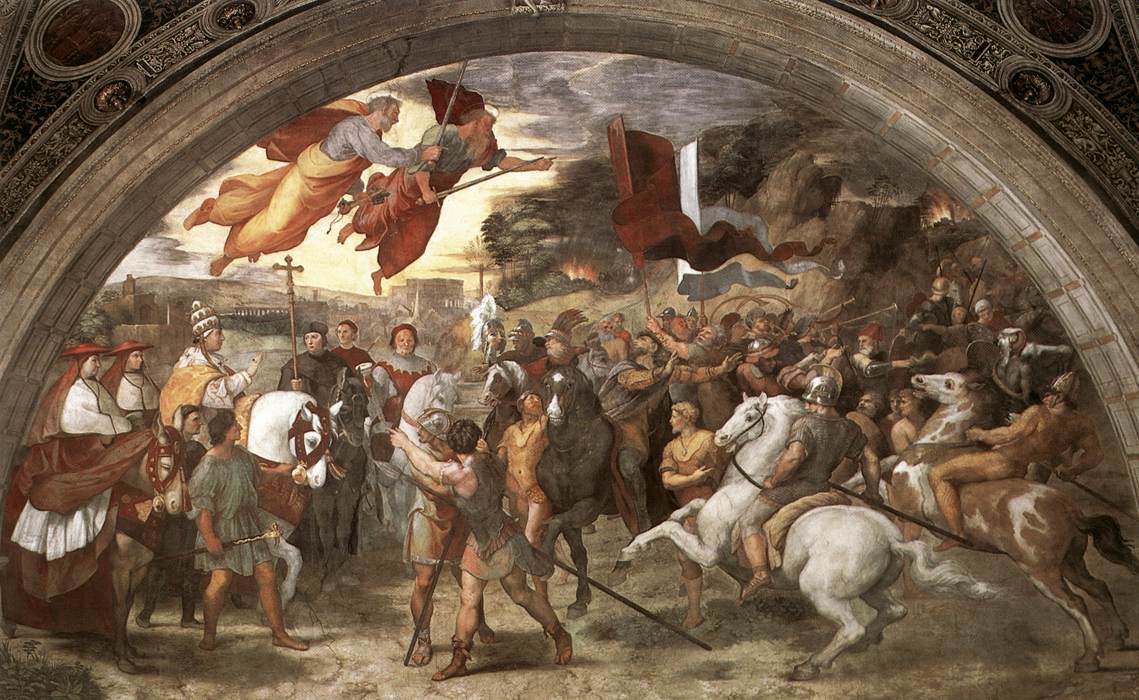
In 452, Attila headed towards Rome, burning cities along the way. Leo rode out to northern Italy to talk to him at Lake Garda, as a consequence of which Attila halted his march and went elsewhere. Or so the story has always gone; Raphael even made a painting about it. It was a bit of a disappointment to read that Leo was only one of three imperial envoys.
For the literature lovers among us: Leo had a good ear for the sound of words, and his prose style (the cursus leonicus) had a long-lasting influence on ecclesiastical Latin.

Leo II (682-683): in his time, the Eastern Roman Empire had a lot of influence in papal elections. He was from Sicily, which was Byzantine territory. There were many Sicilian refugees in Rome, because the island suffered attacks from the Islamic Caliphate.
During his brief reign, he gave official approval to a Church council (Constantinople III).
In light of Leo I’s battle for papal authority, it is ironic that a quote from Leo II has provided an argument against papal infallibility. Leo II condemned Pope Honorius, who reigned half a century earlier, for being lax in the fight against heresy; in doing so, he described Honorius as ‘one who by unholy betrayal has tried to overthrow the unspoiled faith’.

Leo III (795-816): the Pope who on Christmas Day in the year 800 crowned Charlemagne, the first Emperor in the West after the downfall of the Empire three hundred years earlier. (Raphael painted the scene.) Charlemagne was convinced that it was his own duty to defend the Church, and that the Pope should pray for the safety and victory of the Empire.
As Leo I was active in Gaul, Leo III interfered in England – among other things, the home of the scholar Alcuin, whose intelligence and knowledge were invaluable to the school that Charlemagne started at his court. This school created a cultural unity in Europe that endured long after the Carolingian emperors dwindled.
As far as I am concerned, Leo III could be made a patron of ecumenical dialogue. When Charlemagne insisted that he should add the Filioque to the Nicene Creed, Leo refused; not because he disagreed, but because he was unwilling to change the profession of faith that Christians of the East and the West prayed in the liturgy. Not only did he refuse, but he gave the order to write the unchanged Creed on tablets of silver and display them outside St. Peter’s Basilica – a clear ‘in-your-face’ to his friend the Emperor.

Leo IV (847-855): a man whose reign was defined by the fight with the Arabs. These were not distant threats: a year before Leo’s ascension to the papal throne, Saracens invaded Rome and damaged the churches of St. Peter and St. Paul. Leo took the repairs in hand.
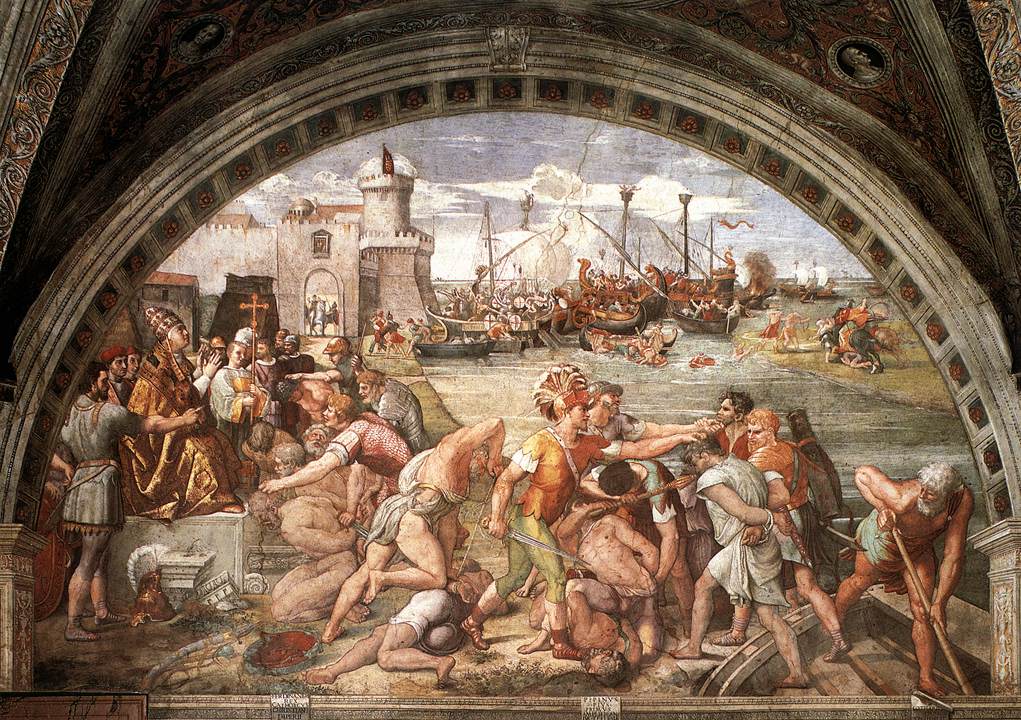
He also organized a naval league of ships from Naples, Gaeta and Amalfi, who defeated the Muslim pirates at the Battle of Ostia in 849. (Raphael painted this, too.) Just as a reminder: Ostia is the harbour where Augustine and Monica talked half a millennium earlier, in preparation for a voyage back to their home in North Africa.
The captives from the Battle of Ostia helped to build the protective Leonine Wall around Vatican Hill, of which a part still stands today.

Leo V (903): he became Pope a year after the completion of the Muslim conquest of Sicily. But he had enemies closer to home. He reigned for two months, and his chief feat is a tax exemption for the canons of Bologna.
After that, a cardinal named Christopher proclaimed himself Pope and threw Leo into prison. It is likely that both were killed in 904 by the next Pope, Sergius III. Thus began the saeculum obscurum, also known as the ‘Rule of the Harlots’: a period in which the papacy was regarded as a source of income and military strength, over which Italian aristocratic families were fighting like dogs over a bone.

Leo VI (928): a Pope who was chosen by the senatrix Marozia, formerly the mistress of Sergius III. Leo’s immediate predecessor had been imprisoned and killed by Marozia.
He does not seem to have been a very bad Pope, mostly concerning himself with the ecclesiastical situation in Dalmatia (in the modern-day Balkan). He also forbade castrates from marrying and sent out a plea for help against Arab raiders. It looks like he died a natural death.

Leo VII (936-939): also chosen by the temporal ruler of Rome. He was possibly a Benedictine and gave many privileges to monasteries, especially Cluny. He also asked them to mediate in disputes.

Leo VIII (964-965): was an antipope before he legitimately became Pope. He was an important official at the court of Pope John XII and served as an ambassador to Emperor Otto I. The two were engaged in a struggle about the Papal States. Ironically, when Leo was sent on his mission to Otto, the Emperor was just besieging the Italian king in his Castle of St. Leo.
Otto marched on Rome; John fled; Otto appointed Leo to the papacy.
Otto left; the Romans rebelled; Leo fled to Otto; another Pope (Benedict) was elected.
Otto came back; Pope Benedict’s staff was broken; Leo was installed again. He spent his papacy conferring favours on the Emperor. This was the end of the saeculum obscurum.

Leo IX (1049-1054): a German Pope, and a saint. He promoted the order of Cluny. After being elected Pope by the Emperor and Roman delegates, he insisted on being officially elected by the clergy and people of Rome.
He reinforced the practice of celibacy and fought against simony (the sale of important positions in the Church). He was also involved in a dispute about Eucharistic theology. It’s good to see the Popes returning to their original calling.
At the time the Byzantines held southern Italy, but they were under attack from the Normans. They asked the Pope for military intervention, thinking that the Normans would be reluctant to fight the Pope. So they were, but they still soundly thrashed the papal forces at the Battle of Civitate (no, Raphael didn’t paint this). After his defeat, Leo went out to the Normans and was received with reverence, even though he was also taken as a captive.
Unfortunately, Leo IX helped set in motion the events that would lead to the great schism of East and West. He quoted (in good faith) a forged letter, supposed to be from Constantine, who had purportedly given authority over the Western Roman Empire to the Pope. This was not accepted in the East, and the impatience of Leo’s legate led to the mutual excommunications of 1054. Leo himself had died shortly before.

Leo X (1513-1521): this one also lived at a time of great schism. This time it was the Reformation, which broke out in 1517. The Ecumenical Council held under Leo’s watch (Lateran V) encouraged reform of the Church, but was not well implemented.
Leo was cheerful, with a pleasant voice and an intellectual sense of humour. He was a patron of the arts (and a big spender), and commissioned Raphael to paint the Vatican stanze. He was involved with the university, with literature, music and antiquities.
He was also the last Pope who was not a priest at the time of his election to the papacy.
Because he wanted to increase his nephew’s political prestige, he joined Spain and England in a war with France. This was disastrous for the papal treasury and soured the relationship between the Pope and the College of Cardinals, which tried to poison Leo. He used the situation to his advantage by executing one Cardinal and nominating thirty-one of his own.
Feeling threatened by the Ottoman sultan, Selim I, Leo tried to organize a truce throughout Western Christianity for the sake of a crusade. This was in 1517. It was a valiant attempt, but it failed, and the religious turmoil that would soon break out made such a peace impossible forever.
In the movie Luther he is depicted as strict and cruel, but the picture I get is that he would be a great conversation partner for dinner (as long as you wouldn’t try to poison him).

Leo XI (1605): nephew of Leo X, from the Medici family. He reigned less than a month. He felt an early vocation to the priesthood, but his mother would hear nothing of it. He became a courtier, was knighted and struck up a friendship with a man twenty years his senior: Philip Neri (later canonized).
After his mother’s death he became a priest, then bishop and cardinal. He fulfilled a diplomatic position in France. Because he was popular with the French cardinals, he was elected Pope rather than Robert Bellarmine (also later canonized). But he was already 70, and the inaugural ceremony wearied him so much that he died within a month. That’s why they called him Papa Lampo, ‘Lightning Pope’.

Leo XII (1823-1829): as an indication of how much times can change, this Leo was the only Pope in his century with a Cardinal for a nephew. Like Leo XI, Leo XII also had experience in a diplomatic position, namely in Switzerland. During his lifetime, Napoleon abolished the Papal States, at which the future Leo secluded himself in an abbey for a few years.
He was conservative in his outlook and did not want to make any compromises with the new revolutionary order. Against French opposition, he was elected Pope, having served the preceding Pope as vicar-general. Because he was physically unhealthy, he had argued against his own election, but to no avail.
He lived frugally and tried to soften the financial strain on the inhabitants of the Papal States (reestablished in 1814) by reducing taxes and other measures. It did little good for the internal economy.
Leo’s conservatism fueled his attempts to get everything in the Papal States under direct Church control, such as schools (where he made Latin the obligatory language) and charitable institutions. Jews were not allowed to own property under his watch, and all residents of Rome were required to listen to expositions on the catechism, whether they were Catholic or not.

Leo XIII (1878-1903): the oldest Pope (died at 93) with the third longest pontificate. The first Pope who ascended the Holy See after the Papal States had been definitively abolished by Victor Emmanuel II. It took a while before the Popes could accept this, and so Leo lived in the uneasy time when the Pope considered himself to be ‘prisoner of the Vatican’.
He made great contributions in the realm of theology. With his encyclical Aeterni Patris, he gave a new impulse to the study of St. Thomas Aquinas, making it normative for seminaries as well as Catholic universities. The importance of Scripture for theology, too, was underscored in Providentissimus Deus. Leo was open to Eastern Christians and wanted to protect their rites, preventing the ‘latinization’ of Eastern Catholics. He also had a strong devotion to the Virgin Mary and was known as the ‘Rosary Pope’.
Of course, he is also (in a sense) the founder of Catholic social teaching, the first Pope to devote an encyclical to social inequality: Rerum novarum. This tried to sketch a middle road between capitalism and communism. Later Popes wrote new and ‘updated’ social encyclicals on various anniversaries of Rerum novarum.
He was the Pope with whom St. Therese of Lisieux had a brief audience.
Leo XIII rests in the Basilica of St. John in Lateran, whose dedication we celebrated yesterday.

To conclude, it is said in an Eastern kontakion to St. Leo the Great:

Seated upon the throne of the priesthood, glorious Leo,
you shut the mouths of the spiritual lions.

Wednesday, 26 October 2016

Magdalena

Magdalena is a book about a woman; more particularly, the author’s mother. The author is Maarten ’t Hart, a famous Dutch author, born in Maassluis in 1944. He was raised in a strongly religious Reformed environment, but lost his faith early in life and became an atheist. He is also a biologist and a lover of classical music.

Unlike Richard Dawkins, Maarten ’t Hart is not given to writing polemical treatises. Many of his works are fragments of memory. Yet he rarely mentioned his mother in other books, because she had asked him not to write about her until her death, which eventually came to pass in 2012.

The author is a subtle painter of portraits. One cannot help feeling a mixture of affection and dismay at many people who feature in Magdalena; most strongly towards the mother herself. Concerned about the well-being of her children (especially the spiritual well-being), but with limited knowledge and interests, and plagued by the recurring delusion that her husband is seeing other women (which leads to frequent bitter tears and recriminations), she is a cathartic character, inspiring pity and fear in equal measure.

The reader is as surprised as the author to discover, after many pages or many years, that young Magdalena shared her bed with one of her father’s servants for multiple years, in utter secrecy but also in complete chastity. Somehow it fits and is quite credible, but not less surprising for that.

The book contains polemical passages against the strict Biblical faith of the author’s youth, sometimes interwoven with the memories. I found it particularly fascinating to read how fourteen-year-old Maarten goes to the harbour to find out how long it takes to get an animal aboard a ship, and then calculates how much time it would have taken to get all two million animal species aboard Noah’s ark – not in order to disprove anything, but out of genuine teenage curiosity. He finds out that the time required amounts to almost three years, which does not correspond to Genesis 7:10, ‘And after seven days the waters of the flood came upon the earth.

His mother (who seems to have had no sense of humour and even less of the absurd – a defect compensated by her son) used to tell him that he should not trouble his head about the Bible, but simply believe like a child. ‘I am a child,’ Maarten would tell her, ‘but I don’t believe like a child.’ And his mother would reply, ‘It’ll come to you when you’re older, then it will be easier for you to believe like a child.’

That it is possible to interpret the Bible differently is not an idea that occurs anywhere in Magdalena; the ‘take it or leave it’ mentality is too strong. [Edit: except perhaps for a passing encounter with a female Protestant preacher, who however offers little of substance.] Catholics are briefly mentioned twice and associated with child abuse both times – for instance in this passage (clunky translation mine):

There I stood, on that deathly silent square next to the train station. The bell of the Great Church was tolling, the clock of the Immanuel Church was tolling, the clock of the Christian Reformed Church was tolling, and I also heard many other ways of tolling. I even seemed to perceive shrill, pedophiliac Papist tolling.

One can hardly deny the pleasantness of the style. It is strange that someone with so many literary gifts should really consider the following argument compelling (although it is not quite clear whether the author still believes in its force, or whether this was a teenage meditation):

Strange, really, that Jesus says that, if you do not accept Him as your Redeemer, you should count on it that after your death you will wail in the outer darkness and gnash your teeth. When you die, and end up in the coffin, your teeth will be there as well. Often those are more or less the last bits of a human that they find after years, so in the outer darkness you will not have any teeth available to gnash with, nor a set of false teeth either.

The book is still quite worth reading, because of the strange real people in it, much stranger than superficial ‘weirdness’. The ending, however, is an anticlimax: it describes the mother’s funeral. The strange circumstances of her death are described with attention and dignity, but the funeral is hardly anything more than a highly negative commentary on the Apostles’ Creed and the Lord’s Prayer. The body may be interred, but it seems that the author is still trying to drown out the sound of his mother’s teeth gnashing over his unchildlike unbelief.

Some of Maarten’s questions, in a modified form, are mine as well. Today I start reading for my studies in fundamental theology, about the theme of divine revelation. Two books have been suggested to me: Models of Revelation, by Avery (Cardinal) Dulles, and Divine Discourse, by Nicholas Wolterstorff. So now I am going to start reading the former, against a musical background of Johannes Ockeghem – the Missa ‘De Plus en Plus’ and the Credo ‘De Village’.

Thursday, 22 September 2016

To Cuiviénen ...

Cuiviénen is (or was) a lake, a ‘starlit mere’, in a forgotten corner of Middle-earth – forgotten because none of the action of The Lord of the Rings takes place there. Its name is derived from cuivië (‘awakening’ or occasionally ‘life’) and nen (‘water’).

It is the place where the Elves wake up. Consciousness stirs in them; they open their eyes and see the stars, the only light present in Middle-earth at that moment. And while they look on those lights, they hear ‘the sound of water flowing, and the sound of water falling over stone’.

Ted Nasmith has made a lovely illustration of the scene.

In a casual aside in the middle of the description, there is this – to me one of the most heart-wrenching passages in the Quenta Silmarillion:

In the changes of the world the shapes of lands and of seas have been broken and remade; rivers have not kept their courses, neither have mountains remained steadfast; and to Cuiviénen there is no returning.

Some of the best stories involve a return; the return to one’s place of birth or old school, or a meeting with an old friend; the comfort of seeing that some things stay the same, the discovery of how you yourself have changed, but also the sweetness of the memory that only the place itself can recall. (For Dutch readers: someone had this experience recently while visiting our house.)

All this is denied to the Elves. To Cuiviénen there is no returning.

I was invited recently to come to an open evening of the Navigators Student Union, a Christian movement that aims to train Christians ‘to know Christ and to make Him known’. It started its ministry to university students at the University of Nebraska, and opened its first Dutch chapter in Delft.

The person who had invited me was temporarily absent, so I knew no one there, but I was cordially invited to come over with one subgroup to the Bible study. A kind student lent me his bike and I accompanied the others through the city to a private room.

During the informal chatting prior to the Bible study, the two other new people asked me what I studied.
‘I just finished my Theology studies,’ I said.
‘How old are you?’ one of them asked.
‘Twenty-six,’ I said.
‘You’re old,’ he deduced.
‘How old are you?’ I said.
He turned out to be seventeen – younger than my brother who is already 7 years younger than I am.

In the course of the conversation, I became uncomfortably aware that I was indeed old. There was a time when I could simply go to meetings like these and present myself as an interested student. But I am no longer a student.
I remember Bible studies from my student years, when I would wait for questions, think about them seriously, and give the best answer I could give (with a strong readiness to debate opponents). Now, I was constantly aware of group dynamics, thinking about the intention behind the questions that were asked, and biting my tongue to refrain from giving all-too-complete answers that would kill thought rather than stimulate it.
The 17-year-old had a vaguely Christian background; he was intelligent and curious, but he did not know what theology was or where the book of Genesis could be found in the Bible. So I did my very best to come across as just another guest (which I was), not as a teacher, even if I was a bit grey around the temples.

It was a good and open conversation, a bit awkward at times, but Bible studies tend to be that.

Still, it was unsettling to sit there, feeling all the time that I was too old for a student group. When did that happen? Was I not irresponsible and free enough to pass for a student? Not filled with grand impractical thoughts, overconfidently expressed theories, shadowy dreams about the future, the urge to know everything about things that were interesting, a serious pretense of seriousness, and a strange docility?

On Saturday, I will go on retreat. One week later, I will be ordained. From that day I will walk around in Delft as a minister (Latin for diakonos) of the Church. It still seems light years away. But when it happens, nine centuries from today, what other things will I be too old for?

To Cuiviénen there is no returning.

But from Cuiviénen there is a road to walk.

Though the beauty of the Quendi in the days of their youth was beyond all other beauty that Ilúvatar has caused to be, it has not perished, but lives in the West, and sorrow and wisdom have enriched it. And Oromë loved the Quendi, and named them in their own tongue Eldar, the people of the stars; but that name was after borne only by those who followed him upon the westward road.